Burgundy 2024 en primeur
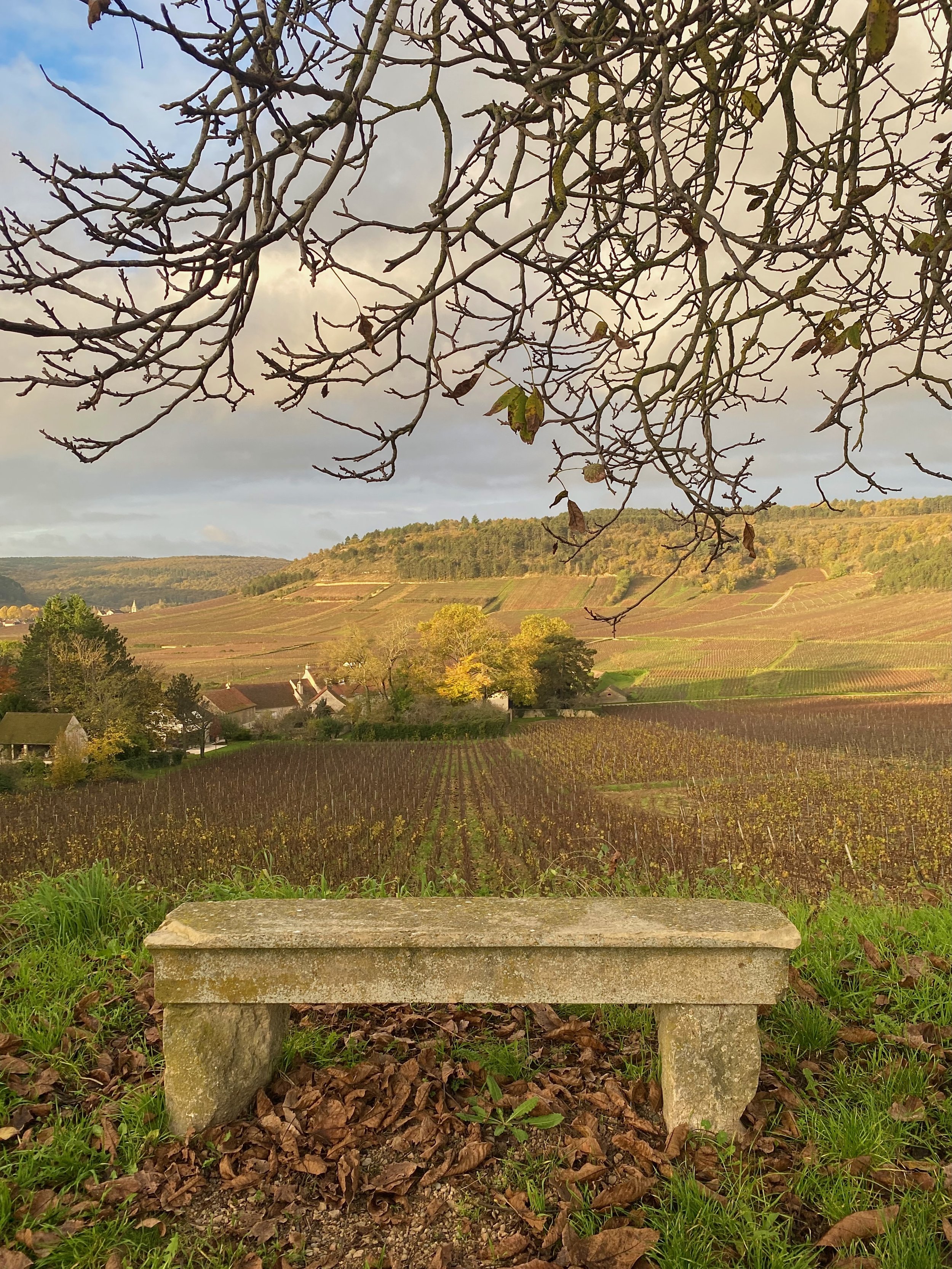
Looking out across the vines behind the village of Monthélie
When I was in Burgundy in November 2024, producers were recovering from the season they had just survived. They were delighted to look back to 2023, a vintage that had been generous – putting to one side the bare cellars where the nascent 2024s lay in wait.
Until now, that is. The 2024s are now being sold en primeur and this last week saw the region’s vignerons descend on London for a range of tastings, showing the wines to both the trade and consumers.
The numbers for 2024 are terrifying, especially for producers who work organically or biodynamically. Losses of up to 90% were not rare, while conventional growers may have managed around half a normal crop, possibly two-thirds if they were lucky.
Why? Well, the short answer is rain. The winter was mild and wet, making for an early start to the growing season, and laying foundations for the disease pressure to come. Frost threatened in mid-late April, but didn’t cause major damage.
In Chablis, hail arrived in early April, but it was a second attack on 1st May that savaged producers’ crops. It was, as Fabien Moreau of Domaine Christian Moreau told me, “une catastrophe”. In a particularly cruel twist of fate, it was the Premiers and Grands Crus that were most severely struck. At Simonnet-Febvre, they didn’t make a drop of Grand Cru. Samuel Billaud lost between 30 and 100% depending on the site.
The dominant factor throughout the season, however, was the rain. At Bouchard, Fréderic Weber explained the cold, hard numbers: 2024 brought twice the rain of a normal season.
The persistent wet weather impacted flowering early on, leading to coulure and millerandage (poor and uneven fruit set), reducing potential yield from the outset. But, it was the resulting disease pressure that really, forgive my language, screwed the region’s vignerons. It was relentless. Richard Séguin (at Olivier Bernstein) noted how 2006 is often considered a reference point for high spray volumes – with 36 cycles of mildew: 2024, however, had twice that.
Many producers abandoned organic or biodynamic certification to protect their crop, and those who didn’t faced hard choices. As the permitted sprays wash off, they had to continually respray after every bout of rainfall. There are, however, limits as to how much copper producers can use each season, and 2024 pushed those to the maximum. As Léo Paul Germain (at Vincent Girardin) explained, sometimes they had to spray three times a week. Given the impact of heavy metals on their soils, was it worth it, some asked. At Nicole Lamarche, Christian Moreau and Bonneau du Martray, they all reached a point where they decided it wasn’t. They sacrificed yield for the long-term health of their vineyards – and they weren’t alone.
Harvest eventually got underway in mid-September – much later than has now become the new norm for the region. Drier weather from 13th provided a window that many leapt at. Fabien Moreau started measuring the sugar levels in his grapes from the start of September, but they refused to rise – and he eventually relented, picking from 20th September. Given the small yields, harvest was – at many addresses – relatively rapid, although slowed by the volume of sorting required. Eric Forest in the Mâconnais took longer than normal, noting that the difference between north-facing and south-facing side of his vines was significant, requiring multiple passes through each site. He eventually finished picking on 6th October.
Yields for Chardonnay was sometimes not too bad – up to around 40hl/ha, although only with conventional farming. Pinot Noir was more severely impacted and, when combined with organic or biodynamic principals, producers were turning out as little as 10hl/ha. It wasn’t just that there weren’t many clusters on the vine in 2024, nor that any mildew-affected berries/bunches had to be sorted out, but that there were fewer berries per bunch, and the berries themselves were small.
Given the tiny yields, in several cases the smallest an estate had ever seen, it was a particularly hard vintage to purchase grapes – meaning fewer négoce bottlings (at AF Gros, for example, there are none at all this year). Indeed, yields were so small that creative solutions were sometimes required. At Duroché, with only 40 litres of their Griotte-Chambertin, they used glass marbles to help fill the barrel and limit the empty headspace. With small volumes in each site, you’ll see more blends this year; at Christian Moreau there is even an “Assemblage Grand Cru” bottling, given the miniscule quantities from most of his Grand Cru sites.
Chaptalisation was universal in 2024, an unavoidable reality of winemaking in a marginal climate. Everything else was, perhaps as ever, a matter of opinion. For the reds, whole-bunch was avoided by some (pointing to stems that weren’t sufficiently ripe, as at Fourrier, or the presence of mildew on the stems, as at Domaine Felettig, for example) and increased by others (helping to soften the naturally high acidity levels, as at Faiveley), while Duroché used the same amount as normal. Extraction was almost universally toned down, with the high skin-to-juice ratio of the small berries requiring a gentle hand. Most vignerons used less new oak for Pinot Noir, feeling the fruit couldn’t handle higher percentages this year, while some producers used more given the tiny volumes.
For the whites, producers’ approaches varied, with more or less new oak, but most seemed to maintain the normal regime. Some winemakers worked the lees more to lend structure, and some are choosing longer élevage, feeling the wines need time to express their terroir. It’s often the opposite for reds, with producers bottling earlier to capture the naturally fresh and juicy style of the wines.
So what does this mean for the quality of the wines, you may ask?
Since I first tasted Samuel Billaud’s 2024s in June, I’ve been excited about the whites – and wider tasting has not disappointed. The wines combine thrilling acidity with concentrated fruit, often displaying a surprising ripeness, a weight of fruit that is balanced beautifully. It is a brilliant year to buy Chablis – the wines classical and pure, yet tightly wound so they should age beautifully. Samuel Billaud was tentatively comparing the vintage to 2014 in Chablis, and not unfairly. In the Côte de Beaune, they don’t have the same austerity as 2014, however that is – for me – in their favour. From my tastings, the quality is also remarkably consistent.
As for the reds, they are significantly more mixed. This is where, perhaps, you can’t outrun the quality of the year – no matter how talented a vigneron you are. It’s a vintage to buy cautiously by producer, but dependable names have turned out some lovely wines. There are, however, some tart and astringent wines, lean and lacking in flesh, occasionally mouth-puckering in profile. At the region’s best producers, you’ll find charming, vibrant reds that offer bright fruit and an open approachability. They are delicately structured and full of freshness, mouth-watering and moreish – but even the best are not wines to tuck away for decades to come.
Drink the open and juicy reds from producers you trust, but be sure to take the whites from 2024 seriously: they deserve it.
